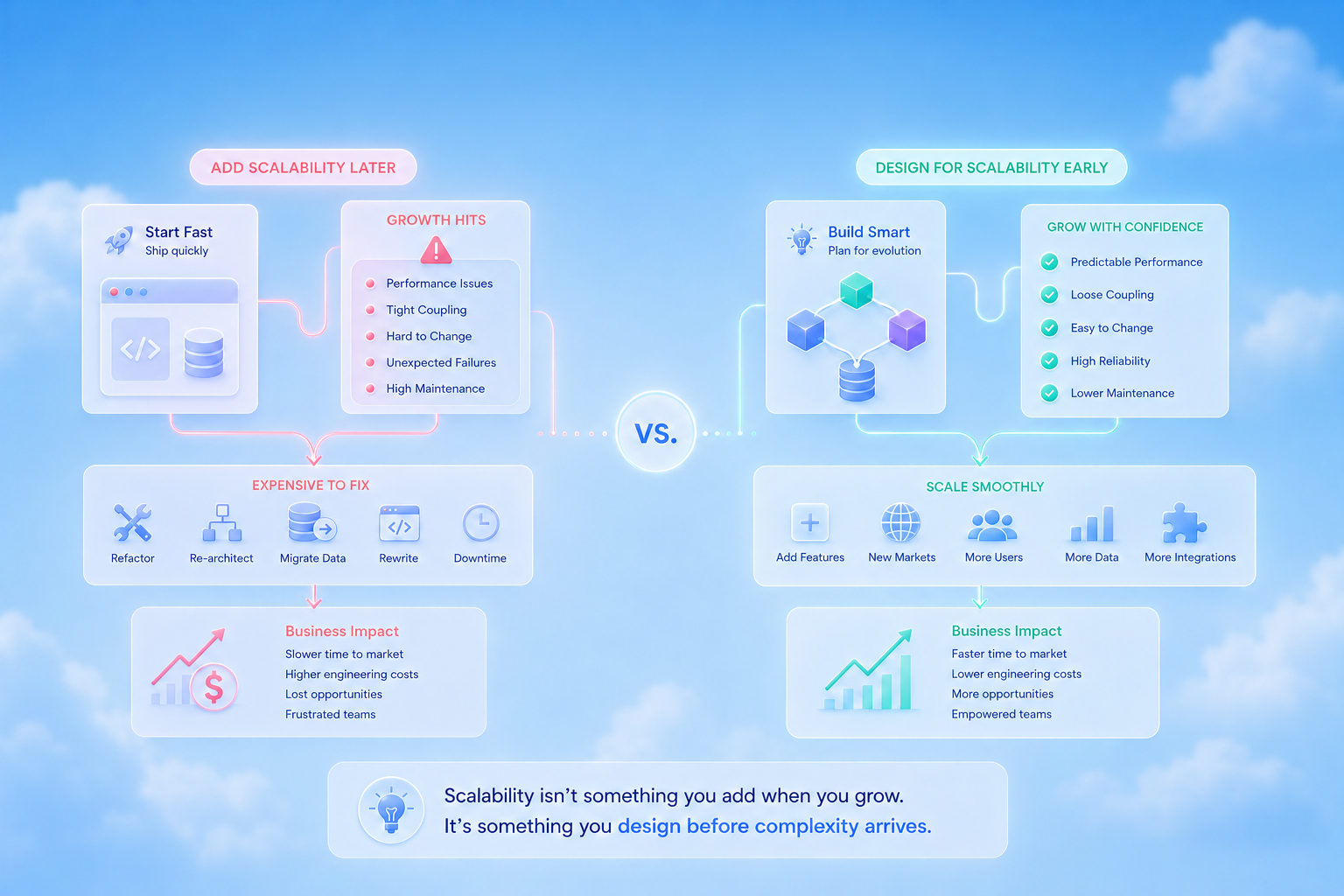
Many companies think scalability is a future problem.
They believe architecture decisions only become important after reaching millions of users, processing large amounts of data, or operating at enterprise scale.
In reality, scalability problems usually begin much earlier.
They begin when systems are designed only to solve today's requirements without considering how the business will evolve.
A system that works perfectly for ten users can become a limitation for ten thousand.
The hidden cost of building only for the present
Early products are usually built around speed.
Teams prioritize launching features, validating ideas, and responding to customer needs.
That approach is necessary.
The problem appears when temporary decisions become permanent foundations.
A database structure designed for a small workflow becomes difficult to change.
A tightly connected service becomes impossible to modify safely.
A manual process becomes a critical dependency.
The company grows, but the system remains designed for the past.
Scalability is not only about performance
Many organizations associate scalability only with infrastructure.
More servers.
More computing power.
More database capacity.
But true scalability involves the entire system:
- How easily new features can be introduced
- How safely teams can modify existing functionality
- How independent different components are
- How clearly responsibilities are separated
- How predictable system behavior remains under change
A system that cannot evolve becomes a business limitation.
A company example: The Single App Trap
Imagine a growing SaaS company that initially builds its platform as a single application.
The product works. Customers are happy. The team moves quickly.
Two years later, the company expands into new markets. New requirements appear:
- Different customer workflows
- Additional integrations
- More complex reporting
- Higher reliability expectations
The problem is not that the original system was wrong. It was simply never designed for the complexity that growth created.
Every new change requires touching multiple areas. Development slows. Risk increases. The team spends more time protecting the system than improving it.
The principle
Scalability is not something added when a company becomes successful.
It is a property created through architecture decisions made before complexity arrives.
The strongest systems are not built only to handle today's requirements. They are designed to adapt when tomorrow's requirements become today's reality.