1. Observation
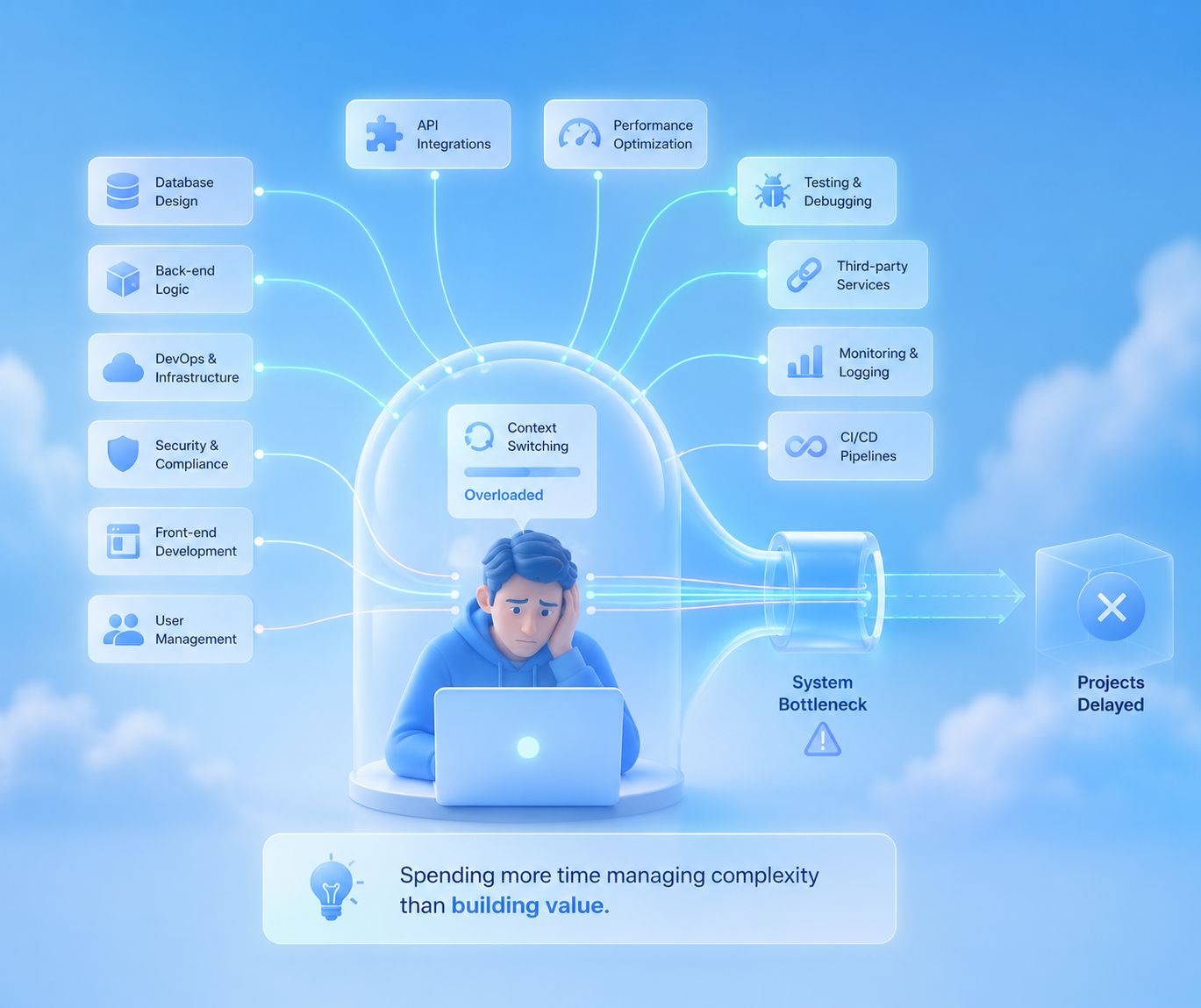
The modern full-stack engineering role has expanded far beyond front-end and back-end development. Today, many organizations expect a single engineer to contribute across product development, cloud infrastructure, AI integration, data pipelines, security, DevOps, and user experience.
2. Structural problem
A single role is absorbing multiple system domains.
As organizations attempt to increase productivity with AI, responsibilities that once belonged to specialized disciplines are increasingly consolidated into one position. While this may reduce headcount, it also removes the architectural boundaries that help teams make consistent technical decisions. The result is not necessarily better execution, but growing complexity concentrated around a single individual.
Case study (fictional example)
A regional logistics company decides to simplify its engineering organization by replacing several specialized positions with two experienced full-stack engineers supported by AI coding tools.
At first, delivery velocity improves. Features are released faster, infrastructure changes happen without waiting for separate teams, and operational costs decrease.
Six months later, however, the same engineers are simultaneously responsible for product decisions, cloud infrastructure, reporting pipelines, security reviews, AI integrations, and customer-facing interfaces. Every new priority interrupts another critical area, architectural consistency begins to drift, and technical debt accumulates despite the team's high productivity.
The problem is not a lack of talent. It is that too many independent system domains have become dependent on the capacity of the same individuals.
3. Visible symptoms
- Constant context switching between unrelated technical domains.
- Superficial architectural decisions in critical parts of the system.
- Growing ownership without clearly defined architectural boundaries.
- Increasing dependence on a few highly experienced engineers.
4. Consequence
Overall output may increase in the short term, but system coherence gradually declines. Local improvements begin creating unintended consequences elsewhere because no one has enough bandwidth to continuously evaluate the system as a whole.
5. Principle
Ownership without clearly defined system boundaries creates invisible bottlenecks.