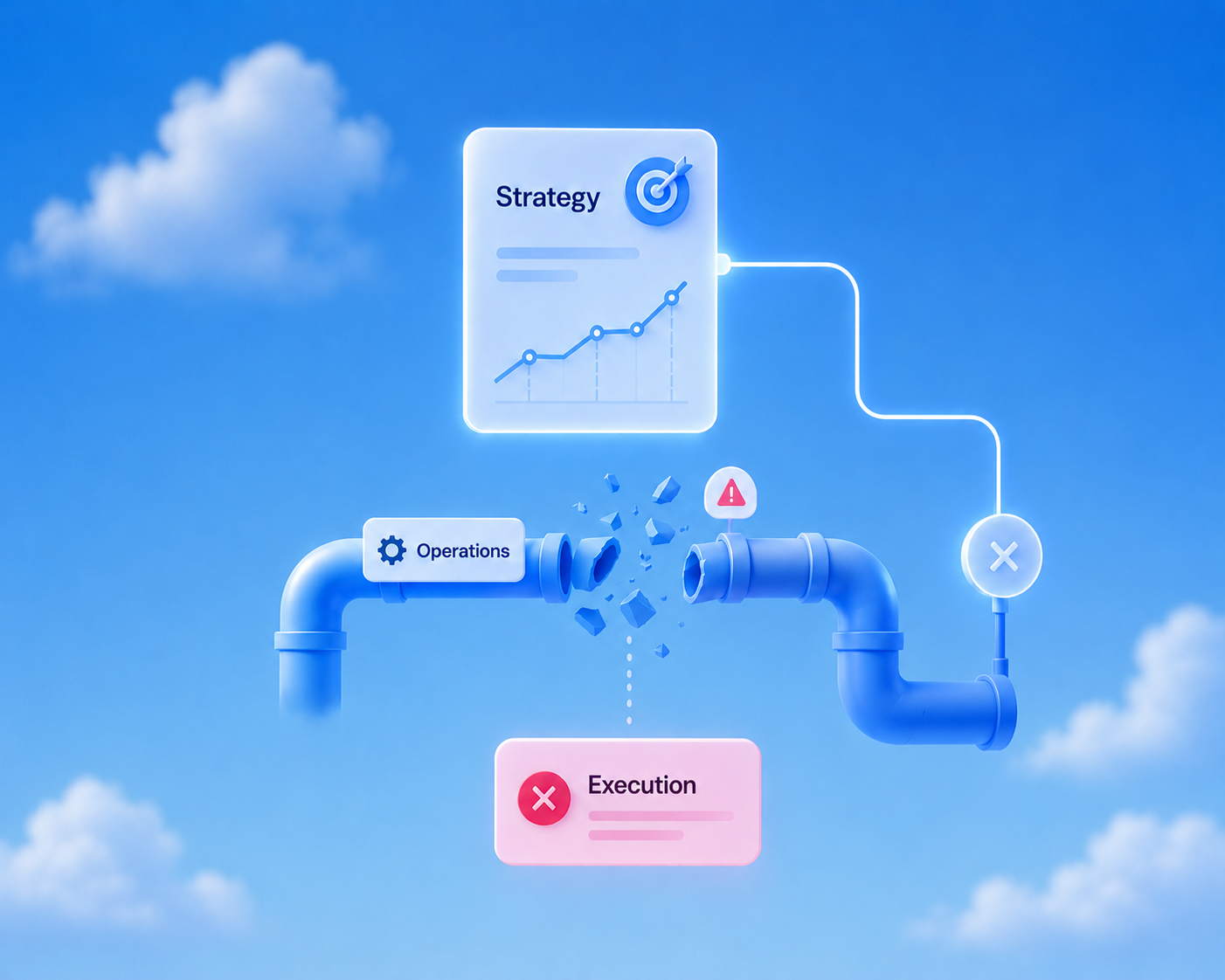
Many companies do not struggle because they chose the wrong strategy.
They struggle because the organization built around that strategy cannot execute it efficiently.
A company can identify the right market opportunity, create a strong product, and have talented people — but still lose momentum when everyday operations become slower, more complex, and increasingly dependent on manual coordination.
The gap between strategy and execution is where operational friction appears.
Growth creates operational pressure
Early-stage companies often succeed because they are flexible.
People communicate directly.
Decisions happen quickly.
Teams solve problems without formal systems.
This works because the amount of information, decisions, and dependencies is still manageable.
But as companies grow, the same methods that created early success can become the source of limitations.
- More customers create more processes.
- More employees create more handoffs.
- More systems create more places where information can become disconnected.
The company is no longer limited by ambition. It is limited by its ability to execute consistently.
What operational friction actually means
Operational friction is the unnecessary resistance between a business decision and the execution of that decision. It appears when:
- Teams need multiple conversations to access basic context.
- Information exists across disconnected tools.
- Employees create manual workarounds to complete normal processes.
- Managers spend more time coordinating than improving systems.
- Critical workflows depend on specific individuals remembering how things work.
- Small changes require significant effort across multiple teams.
Each issue may appear manageable individually. The problem is the accumulation: small inefficiencies become structural limitations.
Why successful companies become slower
Many companies assume that adding more people will solve operational pressure. Sometimes it helps temporarily.
But if the underlying system does not evolve, additional people can increase coordination requirements.
- More employees create more communication paths.
- More tools create more integration points.
- More processes create more opportunities for inconsistency.
The organization grows, but execution becomes heavier.
A fictional example: The Strategy Gap
Consider a growing property management company. The leadership team has a clear strategy: expand into new markets while improving customer experience.
The sales team tracks opportunities in one platform. Property managers maintain operational information in spreadsheets. Customer requests arrive through email and messaging platforms. Finance maintains separate records for billing and reporting.
At a small scale, employees compensate through experience and communication. But as the company expands:
- Customer information becomes inconsistent.
- Teams lose visibility into operational status.
- Reports require manual preparation.
- Decisions depend on information that is already outdated.
The strategy was not the problem. The operational structure was not designed for the next stage of growth.
The solution is not adding complexity
Companies often respond to friction by adding more: more meetings, more dashboards, more tools, and more approval processes.
But complexity does not automatically create control. The objective is not to create more layers.
It is to design systems where information flows clearly, responsibilities are defined, and processes can evolve without constant manual coordination.
The Principle
A strong strategy requires an equally strong operational foundation.
Companies do not scale successfully by increasing effort indefinitely. They scale when their systems allow people to execute better as complexity increases.
The companies that maintain speed during growth are not the ones with fewer challenges. They are the ones that designed their operations to absorb them.