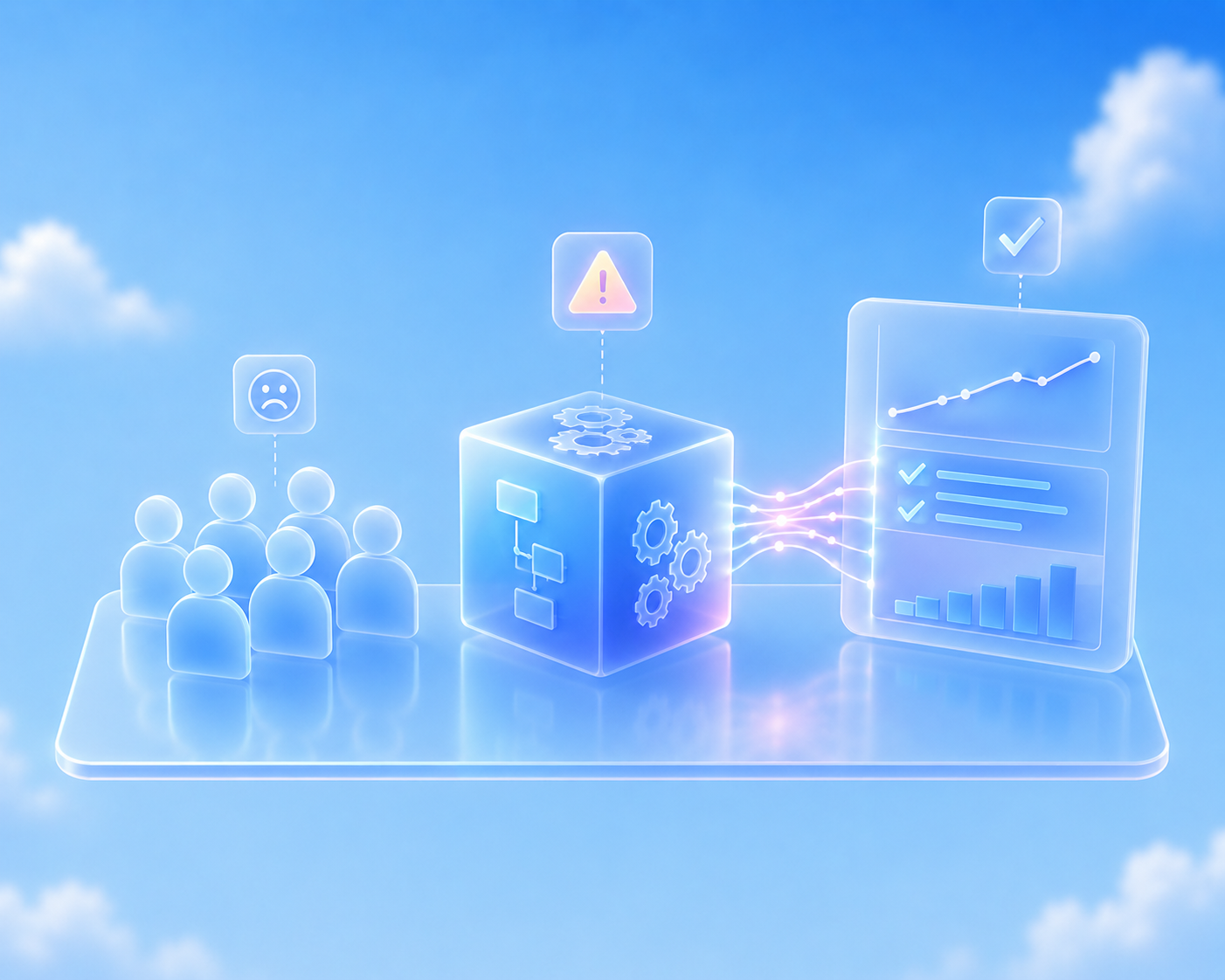
Hiring is often considered the natural consequence of success.
More customers require more employees.
More projects require more teams.
More revenue requires more operational capacity.
And in many cases, hiring is the right decision.
The problem begins when adding people becomes the primary way a company solves every operational challenge.
A company can grow by continuously increasing headcount. But that does not necessarily mean it is becoming more scalable.
Sometimes it means the organization is increasing complexity at the same speed as growth.
The danger of linear growth
A scalable company should ideally increase output faster than it increases resources.
But many organizations follow a different pattern:
- More customers → more employees.
- More employees → more processes.
- More processes → more coordination.
- More coordination → more management overhead.
Eventually, growth creates a new problem: the company needs more people simply to manage the complexity created by having more people.
This creates a growth model where every increase in business volume requires a proportional increase in operational cost. The company becomes larger, but not necessarily more efficient.
The hidden cost of growing without automation
Automation is often discussed as a way to reduce repetitive work. But its bigger value is creating consistency.
Without well-designed systems, employees spend significant time performing tasks that exist only because information does not move efficiently.
Examples:
- Manually transferring data between platforms.
- Creating reports by combining multiple sources.
- Following up on tasks that have no automated workflow.
- Searching for information that should already be available.
- Repeating decisions because previous context was not captured.
These activities may seem small individually. But across an organization, they become a significant operational cost. The company is paying skilled people to maintain processes that should have been improved.
Scaling with people vs scaling with systems
A company that scales mainly through people often looks like this:
- Every new customer requires additional manual coordination.
- Knowledge lives with experienced employees.
- Managers become communication bridges.
- Processes change depending on who performs the work.
- Growth creates more meetings and approvals.
A company that scales through systems looks different:
- Processes are clearly defined.
- Information flows between teams consistently.
- Employees have visibility into the information they need.
- Repetitive decisions are automated.
- Teams can handle more complexity without proportional growth in coordination effort.
The difference is not the quality of the people. Both companies may have talented teams. The difference is the environment those teams operate inside.
A fictional example: The Agency Trap
A digital marketing agency grows from 12 clients to 150 clients. At the beginning, the founders manage relationships directly.
As demand increases, they hire account managers, project coordinators, and additional specialists. Revenue grows. The team grows.
But eventually, the company reaches a point where adding another client requires another person to manage communication, reporting, and coordination. Leadership realizes that the business is no longer limited by market demand. It is limited by operational capacity.
The company redesigns its systems:
- Client information becomes centralized.
- Reporting workflows become automated.
- Project handoffs become standardized.
- Internal processes become visible across teams.
The goal is not reducing the team. The goal is allowing the existing team to create more value.
Systems do not replace people. They amplify them.
The strongest organizations do not avoid hiring. They hire when human expertise creates value. They avoid using people as a permanent solution for problems created by weak processes.
A skilled employee should spend time solving complex problems, making decisions, and creating improvements. They should not spend most of their day compensating for operational limitations.
The Principle
Headcount increases capacity. Systems increase leverage.
Companies that scale successfully understand that growth is not achieved by continuously adding more people to handle complexity.
It is achieved by designing systems that allow talented people to handle greater complexity without becoming overwhelmed by it.