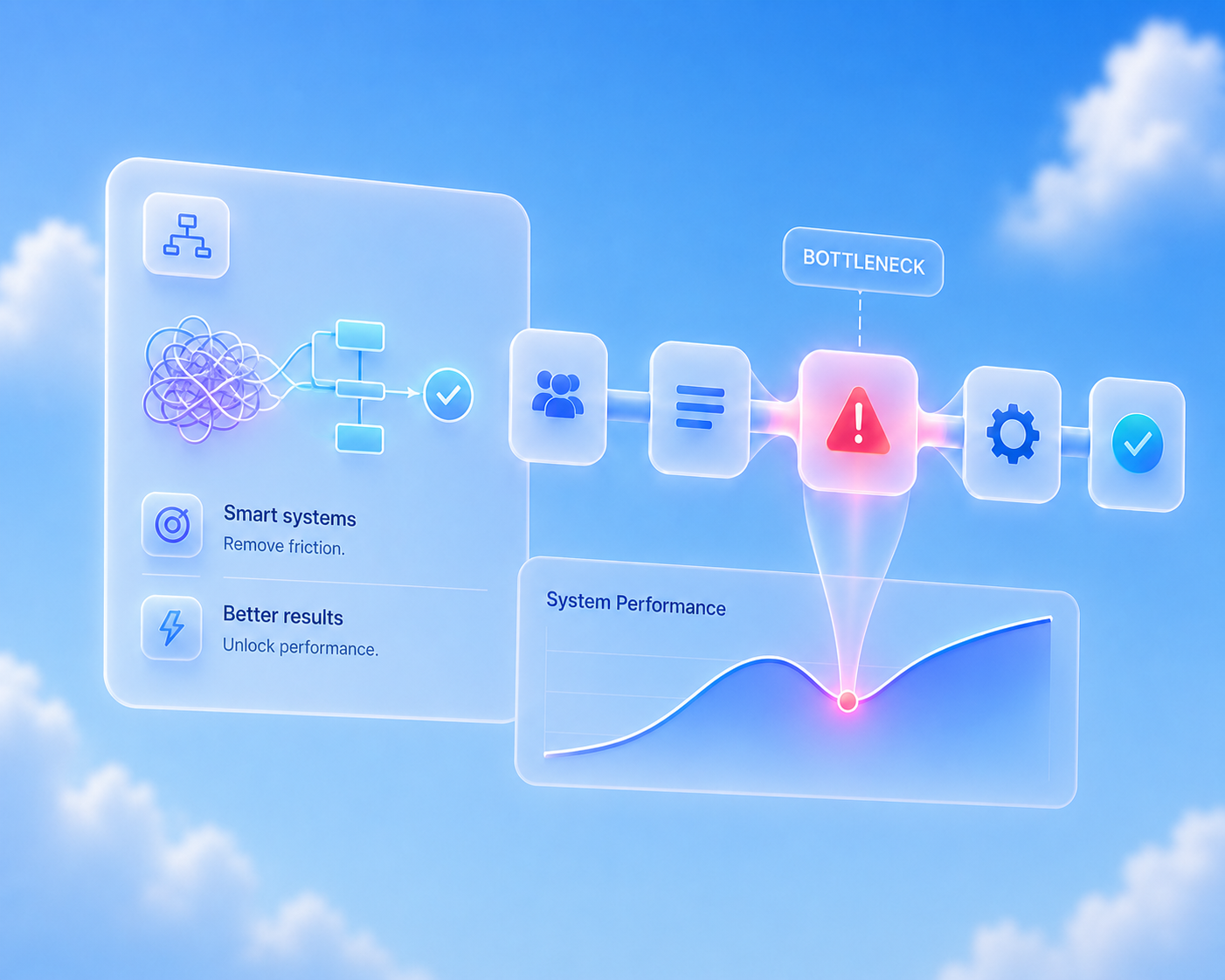
When something inside a company stops working, the first instinct is often to look for a person responsible.
A team is too slow.
A department is not communicating.
Employees are making mistakes.
Managers are not moving fast enough.
Sometimes those observations are correct.
But many organizations make a costly mistake:
They treat system problems as people problems.
They replace employees, add more training, or increase pressure on teams without addressing the structure that created the inefficiency in the first place.
The difference between a talent problem and a system problem
A talent problem happens when the right process exists, the expectations are clear, and the required resources are available — but execution fails.
A system problem is different. It occurs when capable people are placed inside an environment that makes success unnecessarily difficult.
A few examples:
- Sales Forecasting: A sales team is blamed for inaccurate forecasts, but customer information is scattered across multiple systems.
- Operations Overhead: An operations team is criticized for delays, but every request requires manual approval from multiple departments.
- Unclear Ownership: A manager is expected to improve efficiency, but there is no clear ownership of processes or data.
In these situations, replacing people may temporarily change the outcome. But the underlying limitation remains.
How companies create invisible bottlenecks
Many operational problems are not caused by poor performance. They are caused by the way work is designed.
Common examples include:
- Processes that depend on individual knowledge instead of shared systems.
- Teams with overlapping responsibilities and unclear ownership.
- Information that must be manually collected before decisions can be made.
- Workflows designed for a smaller company but still used after significant growth.
- Tools that support tasks but not the complete business process.
The people inside the system adapt. They create workarounds, maintain spreadsheets, send extra messages, and create informal processes. Over time, these adaptations become invisible dependencies.
A fictional example: The Property Management Breakdown
A property management company begins managing a larger portfolio of buildings. Initially, a small team handles everything. One person tracks maintenance requests, another manages tenants, and another coordinates vendors. The process works because everyone knows the context.
As the company grows, more employees join. Management notices delays and assumes the team needs better discipline. They hire additional coordinators and introduce more meetings.
However, the real issue is that maintenance requests, vendor information, tenant history, and approvals are managed through disconnected tools and manual communication.
The company does not have a staffing problem. It has a workflow design problem.
A redesigned operating model introduces:
- A centralized request lifecycle.
- Clear ownership between teams.
- Automated status updates.
- A reliable source of operational information.
The same people can now handle significantly more work because the system supports them.
More effort cannot compensate forever for poor design
Companies often reward employees who are good at overcoming broken processes. They become the people who "know how everything works."
But this creates a hidden risk. The company becomes dependent on exceptional individuals instead of reliable systems.
High-performing employees should improve the system. They should not become the system.
The Principle
People are responsible for execution. Systems are responsible for enabling consistent execution at scale.
When organizations repeatedly experience the same problems with different people, the issue is rarely the people.
The question is not: “Who is failing?”
The better question is: “What environment are we asking people to succeed inside?”
Companies scale when they stop solving structural problems with individual effort and start designing systems that make success repeatable.