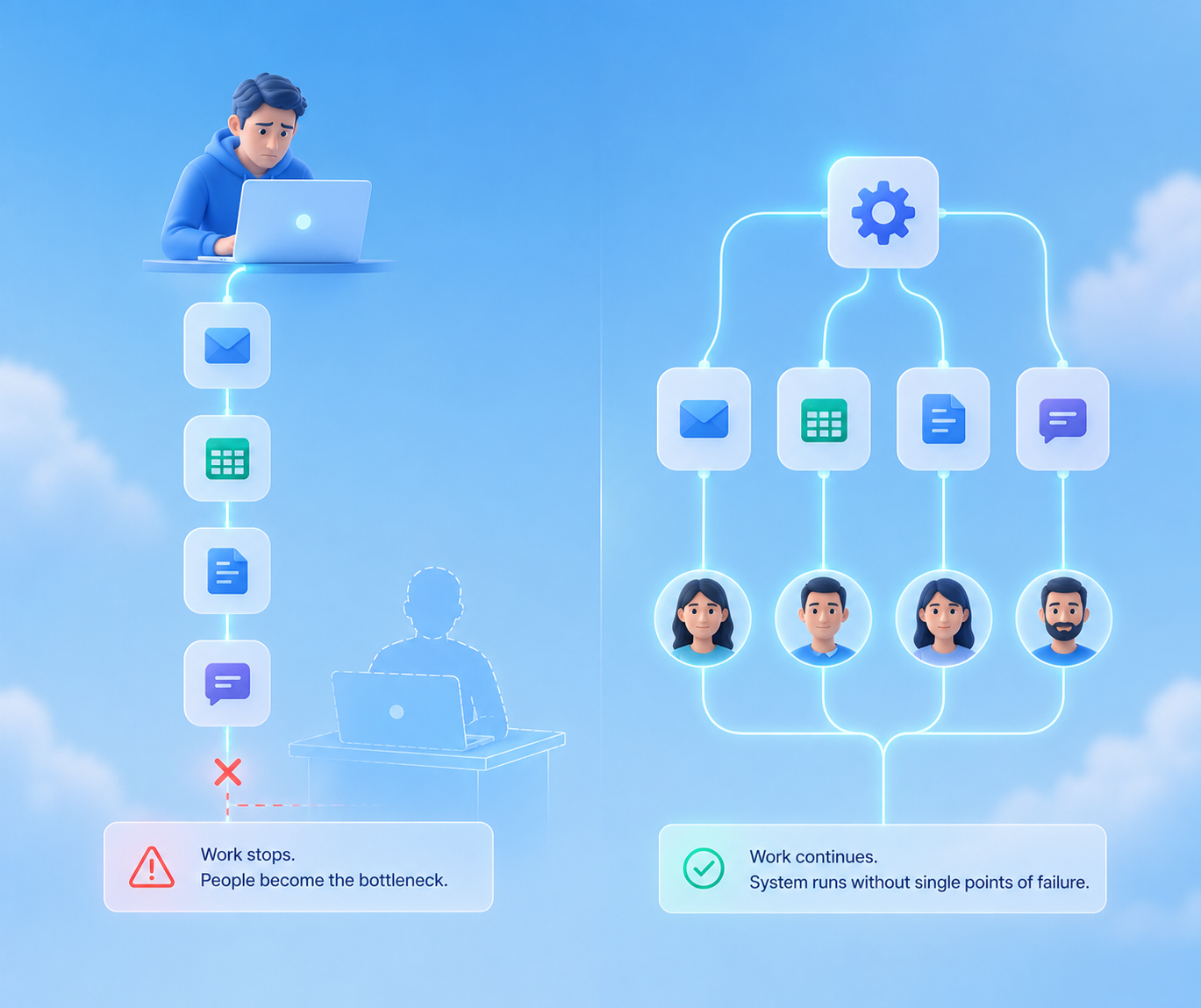
Every company has key employees.
People who understand how things work.
People who know where information is located.
People who can solve problems faster because they have years of accumulated context.
These individuals are valuable.
The problem begins when the company depends on their memory, relationships, and personal knowledge to function.
At that point, the organization is not benefiting from expertise. It is depending on a single point of failure.
The hidden risk of human dependency
Many operational dependencies are created unintentionally.
A person becomes responsible for a process because they were the first person to handle it. They know which exceptions exist. They know who to contact. They know the unofficial steps required to complete the work.
Over time, the process becomes impossible to separate from the person.
The company may have documentation, tools, and procedures. But the real operating system exists inside someone's experience.
Documentation is not the same as system design
Many organizations try to solve dependency by creating more documentation. They write manuals, create internal guides, and record training videos.
Documentation is useful. But documentation alone does not create scalability.
A document explains what someone should do. A system defines how work moves. A strong operational system includes:
- Clear Ownership: Accountability is assigned and clear.
- Defined Workflows: Clear process stages and pathways.
- Accessible Information: Shared data is visible to all who need it.
- Automated Handoffs: Handoffs occur automatically without manual messages.
- Visibility: Real-time visibility into status and responsibilities.
The goal is not simply preserving knowledge. The goal is designing operations where knowledge does not need to be manually transferred every time someone changes roles.
How fragile operations reveal themselves
Companies with high human dependency often show similar patterns:
- Employees frequently say, “Ask Sarah, she knows how this works.”
- New hires take months to become effective.
- Processes change depending on who performs them.
- Teams create personal spreadsheets to manage critical information.
- Managers spend time solving recurring problems.
- A vacation creates unexpected operational delays.
- Leadership worries about what would happen if a key employee left.
These are not signs that employees are doing something wrong. They are signs that the organization has not converted individual expertise into organizational capability.
A fictional example: The Logistics Breakdown
A logistics company has an operations manager who has been with the business for seven years. Everyone depends on this person: they know which suppliers are reliable, understand customer priorities, and know how to handle unusual situations.
When the company grows, leadership believes this person is simply excellent at their role. But when they take extended leave, operations slow down immediately.
The team discovers that important decisions were never captured in workflows or systems.
The solution is not replacing the employee. The solution is transforming individual knowledge into a repeatable operating model:
- Supplier information becomes structured.
- Escalation paths become defined.
- Processes become visible.
- Exceptions become documented within the system.
The company does not lose expertise. It makes expertise scalable.
Resilient companies design beyond individuals
Great employees create value. Great systems preserve and multiply that value.
A company should not remove human judgment from important decisions. Complex businesses need experience, creativity, and expertise.
But critical operations should not depend on one person's memory to continue functioning.
The Principle
If an employee leaving creates operational paralysis, the problem is not the employee. The problem is that the organization has not converted individual knowledge into a system.
Scalable companies do not eliminate dependency on people. They eliminate unnecessary dependency on specific people.