Most companies celebrate growth as a sign that they are doing things right.
More customers.
More revenue.
More employees.
More opportunities.
But growth introduces a problem that many organizations underestimate: coordination starts becoming the hidden cost of growth.
The company that worked at 20 people is not automatically the company that works at 100. The processes that once lived inside conversations, relationships, and individual knowledge start becoming invisible dependencies.
When every team grows, alignment becomes the bottleneck
In early-stage companies, information moves naturally. Sales understands what customers need because they speak directly with delivery teams. Operations knows where problems exist because leadership is close to daily execution. Everyone shares context.
But as companies expand, teams begin optimizing around their own responsibilities:
- Sales focuses on closing opportunities.
- Operations focuses on execution.
- Delivery focuses on fulfilling commitments.
- Finance focuses on controlling costs.
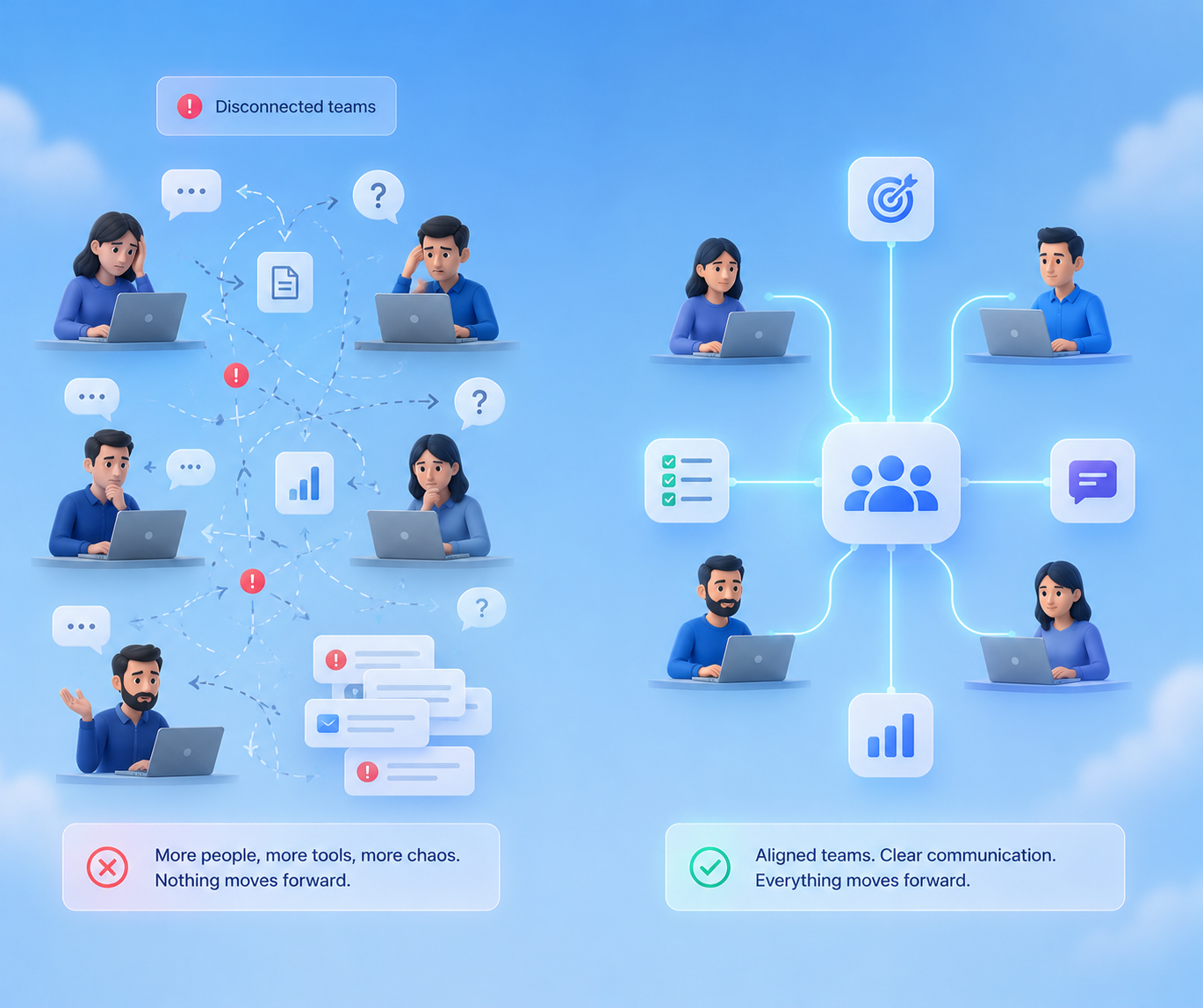
Each function may be performing well individually, while the connections between them become weaker. The problem is not that teams are failing. The problem is that the system connecting those teams was never designed for the new level of complexity.
Why hiring more people can make the problem worse
When companies experience operational pressure, the most common response is adding capacity: another project manager, another operations specialist, another coordinator.
Sometimes this is necessary. But when the underlying issue is coordination, adding more people can increase the number of communication paths, dependencies, and handoffs that must work correctly.
- More people create more information flow.
- More information flow creates more opportunities for misalignment.
Without better systems, companies often solve short-term pressure while increasing long-term complexity. The organization becomes larger, but not necessarily more scalable.
The hidden signs your company has a coordination problem
Many companies do not notice operational friction until it becomes expensive. Common signals include:
- Silod Processes: Teams creating their own processes because no shared system exists.
- Data Duplication: Different departments maintaining different versions of the same information.
- High Communication Overhead: Employees spending significant time asking for updates instead of executing work.
- Leadership Bottlenecks: Leadership becoming the connection point between teams.
- Key Person Dependency: Important decisions depending on specific individuals who hold critical context.
- Meeting Proliferation: Projects slowing down because every change requires additional alignment meetings.
- Slow Onboarding: New employees struggling to understand how work actually moves through the organization.
Often, these are not signs of bad management; they are signs that the operating model has not evolved with the company.
A fictional example: Coordination Breakdown
A software company grows from 15 employees to 120 employees in two years.
At the beginning, the entire team shares customer context. A salesperson can walk to an engineer's desk and explain a customer request. The operations team knows exactly what is happening across projects.
After growth, the same company has separate sales, customer success, engineering, and delivery teams. A customer request enters through sales, gets documented in one tool, discussed in another, tracked in spreadsheets, and eventually reaches the engineering team with missing context.
Nobody made a bad decision. Nobody failed. The company simply outgrew the informal coordination mechanisms that worked during its early stage.
The solution is not another meeting. It is designing a system where information moves reliably without depending on constant human intervention.
Scaling is not about adding more people. It is about increasing organizational capacity.
The companies that scale successfully understand that growth is not only a resource problem. It is a systems problem.
A business should not require more coordination effort every time it adds more customers, employees, or complexity. The goal is not to eliminate people from the process. The goal is to create systems where people can focus on decisions, creativity, and high-value work instead of constantly repairing communication gaps.
The Principle
Growth exposes the weaknesses that were invisible during the early stages of a company. A business does not become scalable when it becomes bigger. It becomes scalable when its systems allow it to become bigger without creating proportional complexity.
The companies that grow efficiently are not the ones with the most people. They are the ones that design better ways for those people to work together.